The AI gold rush is entering a new phase. If you think you’ve missed the boat because you didn’t buy Nvidia at the bottom, you’re looking at the wrong map. While the world is obsessed with “digital brains” (GPUs and LLMs), a massive physical reality check is coming. By the second half of 2026, when these massive AI Infrastructure projects actually go live, they are going to hit a physical wall.
To stay ahead, we need to look at the “boring” sectors that are becoming the backbone of the next decade. Here are the three physical bottlenecks that will define the AI Infrastructure trade for the next 5 years.
1. The Water Scarcity Crisis in AI Infrastructure

We talk about electricity constantly, but we forget that data centers are incredibly thirsty. High-performance AI chips generate an insane amount of heat, and the most common way to cool them is through evaporation. Imagine this: every time an AI generates a few paragraphs, it “consumes” nearly 500ml of water.
By 2026, Water Usage Effectiveness (WUE) will move from a boring corporate metric to a life-or-death requirement for data center permits. In hotspots like Northern Virginia or Texas, the limit isn’t just power anymore—it’s the local water table. This is where companies like Xylem ($XYL) and Badger Meter ($BMI) become indispensable.
Xylem isn’t just a pump company; they are the architects of water recycling. As data centers are forced to reuse every drop of wastewater, Xylem’s treatment tech becomes a non-negotiable requirement for any AI Infrastructure site. Meanwhile, Badger Meter’s smart analytics are the only way operators can prove to regulators that they are being efficient. These aren’t just utility stocks; they are the “water guards” of the revolution.
2. Copper: The Conductive Backbone of the Grid
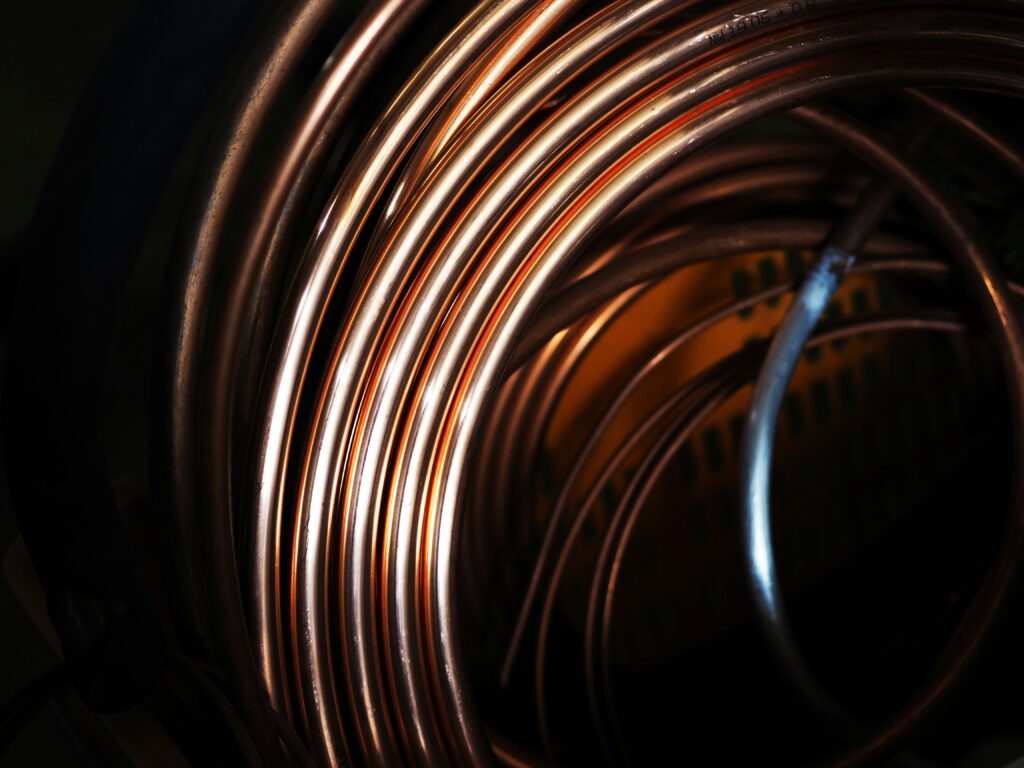
Everything in the digital world runs on copper. From the miles of wiring inside a server rack to the massive upgrades needed for our aging power grids, copper is the “New Oil.” Currently, we are seeing a “Triple Threat” of demand: AI Infrastructure, the global transition to EVs, and a desperate need for grid modernization.
The problem? You can’t just “code” more copper into existence. It takes a decade or more to bring a new mine online, and we are currently facing a structural supply deficit. This makes copper a long-term “Super Cycle” play. Freeport-McMoRan ($FCX) sits at the throne here. As one of the world’s largest pure-play copper miners, they are the most direct way to bet on this shortage. When copper prices spike, the leverage on their earnings is massive. If you believe the world needs to be electrified for AI, you have to believe in $FCX.
3. Subsea and Fiber: The World’s Nervous System
As AI moves from “training” to “inference” (answering billions of user queries daily), the sheer volume of global data traffic is going to hit the roof. People forget that 95% of our digital world lives in cables at the bottom of the ocean.
We are seeing a massive shift where Big Tech giants like Meta and Google are building their own private subsea highways to support their AI Infrastructure. Corning ($GLW) is the undisputed king of the fiber optics needed for these routes. They are currently expanding factories just to keep up with the demand for high-density cables. On the maritime side, Prysmian ($PRYMY) is the leader in actually laying these deep-sea lifelines. Without these two, the AI in your pocket can’t talk to the data center across the ocean.
Why This Matters for 2026 and Beyond
The “easy money” in AI software might have been made, but the “real money” in physical AI Infrastructure is just getting started. We are moving from a world of digital dreams to a world of physical constraints. Investors who recognize these bottlenecks early will be the ones who thrive in the 2026 super-cycle. Don’t just follow the hype—follow the resources that make the hype possible.